
Quick access: Google Earth in numbers, compare the versions, download and install, Google Earth Pro, best Pro features, see a street, measure an area, change the date, see your house, go to Street View.
What is Google Earth?
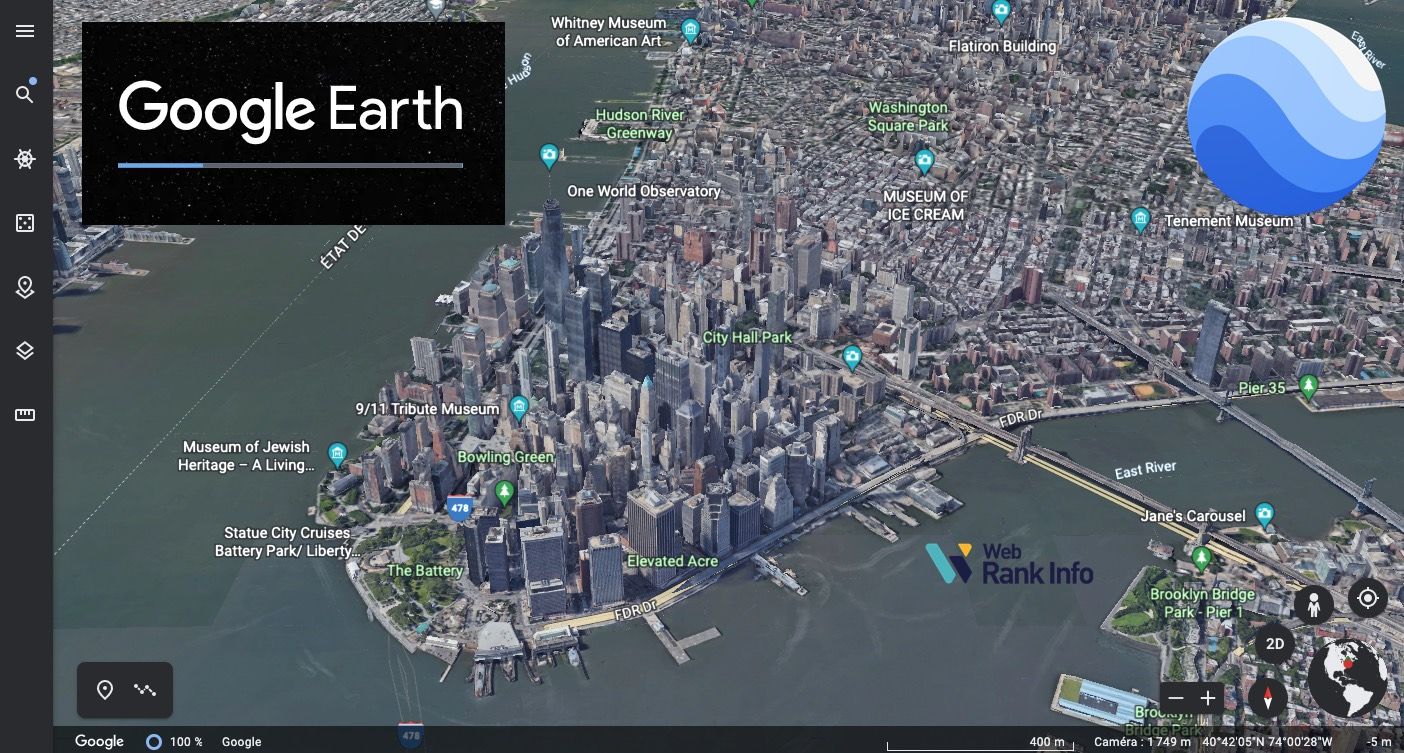
Google Earth is a free application from Google that lets you fly over any point on the planet, in ground-level or aerial view. You can browse the Earth through satellite and aerial imagery, in 2D or 3D, search for places (restaurants, hotels, monuments…) and plot road routes.
The software has a surprising origin: it started life as EarthViewer 3D, built by a startup called Keyhole Inc. — a company partly backed by In-Q-Tel, the venture-capital arm of the CIA. Google acquired Keyhole in 2004 and relaunched the product under the name Google Earth in 2005. That intelligence-agency DNA is part of why the tool felt so far ahead of its time when it landed on ordinary computers.
What can I do with Google Earth?
Google Earth lets you see almost any place on the globe the way satellites do. Resolution varies from one area to another, but strategic locations (large cities) are often covered in extremely fine detail — sometimes sharp enough to make out individual cars in the street.
To use it, just type a place name (adding the country if needed) to travel there. The application streams everything from the Internet in real time: satellite images, street names, roads, cities, and the location of hotels, restaurants and other points of interest.
Beyond the classic top-down view, you can tilt the camera angle to see the landscape in relief, adjust the altitude of your viewpoint, and of course rotate the map freely. Tip: hold the Ctrl key (or the middle mouse button) while dragging to tilt and rotate at the same time — it’s the fastest way to switch from a flat map to a dramatic 3D fly-through.
You can save places to memory, add your own comments, and even generate turn-by-turn routes to get from any point on the globe to another.
Google Earth in numbers
A few figures put the sheer scale of Google Earth into perspective:
- 1 billion+ downloads: the desktop client passed the one-billion-download mark as far back as October 2011 (source: Google / Forbes).
- ~3 petabytes… and climbing: a widely cited independent estimate put the Google Earth imagery database at roughly 3 PB in 2016 — and it has grown enormously since (newer estimates run into tens of petabytes). Google has never published the exact figure.
- 98% of the world’s population: Google Earth’s high-resolution imagery spans about 36 million square miles, covering roughly 98% of where people actually live (source: Google, 2019).
- 220 billion+ Street View images: collected across 100+ countries and territories and more than 10 million miles of roads — enough to circle the planet over 400 times (source: Google).
- Landsat since 1972: Google Earth relies partly on NASA/USGS’s Landsat program, the longest-running Earth-observation mission, which images the entire planet roughly every two weeks at 30 m resolution.
- 80+ petabytes in Earth Engine: the sister platform Google Earth Engine hosts a public catalog of more than 80 petabytes and over 40 years of imagery for scientific analysis.
- 37 years in a Timelapse: Google Earth’s Timelapse feature stitches together nearly four decades of satellite imagery so you can literally watch coastlines, glaciers and cities change.
- 80 million+ 3D trees: Google modeled tens of millions of individual trees in 3D starting with Google Earth 6.
- $399/year → free: Google Earth Pro used to cost $399 per year until Google made it completely free in January 2015 (source: TechCrunch).
The versions of Google Earth
Google Earth is available in 3 main versions:
- Google Earth on the web, directly in your browser
- Google Earth mobile, as an app for phones and tablets
- Google Earth Pro, the free software to install on a computer
There are also several companion tools:
- Google Earth Studio (browser-based animation software)
- Google Earth Engine (planetary-scale analysis in the cloud)
- Google Earth VR (on compatible headsets)
- Google Earth Outreach (for non-profits and solidarity projects)
- Google Earth Education
For the record, at its original launch the software existed in several paid tiers, none of which ran in a browser (all had to be installed):
- Google Earth (free)
- Google Earth Plus cost $20 per year; it added GPS device support, spreadsheet data import, drawing tools and better printing
- Google Earth Pro cost $400 per year; aimed at professionals, it added area calculation, a video generator, high-end printing, GIS data import and more (it is now free)
- Google Earth Enterprise was a set of business solutions for deploying commercial services in hosted mode (Google Earth Fusion and Google Earth Server)
Google Earth Web vs Mobile vs Pro: comparison table
Not sure which version to use? Here is a side-by-side comparison of the three main flavours of Google Earth. All three are 100% free.
| Feature | Google Earth Web | Google Earth Mobile | Google Earth Pro (desktop) |
|---|---|---|---|
| Installation | None (runs in a browser) | App to install | Software to install |
| Platforms | Chrome, Edge, Firefox, Opera | Android, iOS / iPadOS | Windows, macOS, Linux |
| Price | Free | Free | Free |
| 3D view & 3D buildings | Yes | Yes | Yes |
| Street View | Yes | Yes | Yes |
| Historical imagery (time travel) | Limited | Limited | Yes (full archive) |
| Measure distance | Yes | Yes | Yes |
| Measure area / perimeter / radius | Basic | Basic | Yes (polygons & circles) |
| Import / export GIS data (KML, SHP…) | Import KML/KMZ | Limited | Yes (KML, SHP, TAB, CSV) |
| High-resolution printing / export | Standard | Standard | Yes (up to 4800×3200 px) |
| Movie / animation recording | No | No | Yes (HD Movie Maker) |
| Flight simulator | No | No | Yes |
| Best for… | Quick access, nothing to install | Exploring on the go | Professionals, GIS, presentations |
Google Earth on the web
This version is very easy to use: just open your browser and go! You can immediately travel around the world and visit hundreds of cities virtually, including in 3D. A dice icon even lets you jump to a random destination for a bit of serendipity.
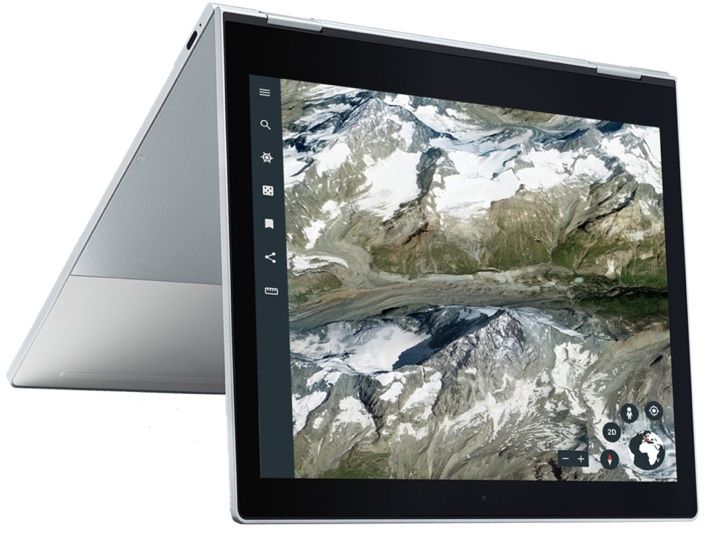
At launch in 2017 the web version worked only in Chrome, but that’s no longer the case: since 2020 Google rebuilt it on the open WebAssembly standard, so it now runs in Chrome, Microsoft Edge, Firefox and Opera (as well as Chromium-based browsers like Brave and Vivaldi). On some browsers you may see a message warning you that performance can be slightly slower than on Chrome.
Google Earth on mobile

You can install the Google Earth app for phone or tablet — it’s available on Android and iOS.
Explore the whole world from above with 3D satellite imagery, global 3D terrain and 3D buildings in hundreds of cities. Tip for iPhone/iPad users: because the mobile app is fully featured, it’s often the best way to get the Google Earth experience on Apple devices without worrying about browser compatibility.
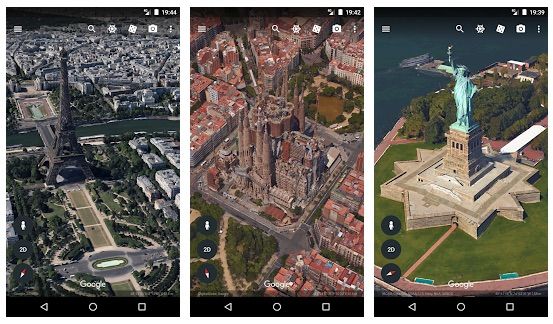
Zoom in on your home or anywhere else, then dive in for a 360° perspective with Street View. Roll the dice to jump from place to place, or explore Voyager — a collection of guided tours from partners such as BBC Earth, NASA and National Geographic. Touch the ruler icon to measure distances and areas anywhere on Earth.
Google Earth Pro on a computer
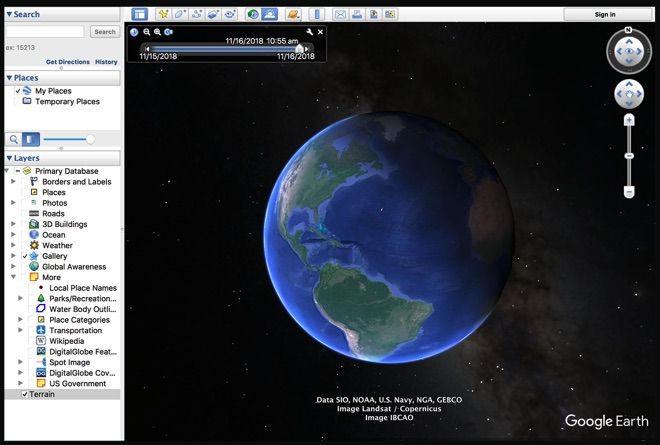
For more advanced use, install the Pro version — and yes, it’s free! It’s available on Windows, macOS and Linux. Import and export GIS data, measure areas and perimeters, travel back in time with archive imagery, and record HD videos of your fly-throughs.
Best features of Google Earth Pro
Since it went free in 2015, Google Earth Pro is a genuinely powerful — and often overlooked — professional GIS-lite tool. Here are the features that make it worth installing:
- Area, radius & perimeter measurement: draw polygons and circles to measure surfaces, not just straight-line distances (see the step-by-step below).
- High-resolution export & printing: save and print images up to 4800×3200 px, ideal for reports, planning documents and presentations (the old free version was capped around 1000 px).
- Bulk address import (batch geocoding): import a CSV or TXT spreadsheet of up to 2,500 addresses at once and Google Earth Pro will geolocate each one and drop a placemark — perfect for mapping a customer or store list.
- GIS data import: load ESRI shapefiles (.shp) and MapInfo (.tab) files to overlay points, lines and polygons on the globe.
- HD Movie Maker: record your virtual tours as HD videos (up to 1920×1080) to share.
- Full historical imagery: the complete time-slider archive lets you see how a place has changed over years or even decades.
- Viewshed & elevation profiles: see what is visible from a chosen point, and read the elevation profile along any path — useful for hiking, telecoms or solar planning.
- Demographic, parcel & traffic-count layers: extra data layers (mainly for the US) that help with site selection and market analysis.
Google Earth Tips
How to download Google Earth for free?
The software is available in many languages, and you can download it for free in a Windows PC, Mac or Linux version.
- to download Google Earth for computer, click here
- to download Google Earth Pro for computer, click here
Good to know: on the desktop, “Google Earth” and “Google Earth Pro” are now the same free application — there’s no longer a paid tier or a license key to buy.
Can I use Google Earth on a Mac?
Yes, of course! You can use it directly in a browser (Chrome, Edge, Firefox or Opera) or install the Google Earth Pro application for macOS.
How to install Google Earth Pro (free)?
To install or update the software, download the application and launch the installer. You’ll be guided through the necessary steps. The installation is standard — just run it as a computer administrator.
System requirements:
- on Windows PC: Windows 7 or later, 1 GHz processor or faster (2 GHz recommended), 2 GB memory (4 GB recommended), 2–4 GB free disk space, DirectX 9 (11 recommended) or OpenGL 1.4 (2 recommended).
- on Mac: macOS 10.8 or later, 64-bit processor, 4 GB memory, 4 GB free disk space, OpenGL 2.
How to use Google Earth online (without installing anything)?
Just open Google Earth in your browser at earth.google.com/web. This version is also called “Google Earth for the web” or simply “Google Earth online”. It works in Chrome, Edge, Firefox and Opera.
Why doesn’t Google Earth work anymore?
Check Google’s support page for help with the following problems:
- Troubleshooting Google Earth
- I can’t sign in to my Google account
- How to fix blurry or outdated images
- How to fix crashes and display problems
- How to stop the globe from spinning
- How to delete files to free up memory
- How to improve performance
Quick fix: a large share of display bugs come from graphics drivers. In Google Earth Pro, go to Tools > Options > 3D View and switch the “Graphics Mode” between OpenGL and DirectX — that alone resolves many crashes on Windows.
Why is Google Earth not up to date?
You can enable automatic updates for Google Earth Pro during installation. If you haven’t, update the software manually by downloading it again from Google.
Bear in mind that imagery itself isn’t “live”: each area is refreshed on its own schedule — every few months for busy or fast-changing places, but only every few years for rural or remote regions.
Which is the best version of Google Earth? Which one to choose?
The simplest and most convenient option is probably the Google Earth mobile app; if you’d rather not install anything, use Google Earth on the web. Only install Google Earth Pro on your computer if you need the advanced features (area measurement, GIS import, HD movie export, full historical imagery). See the comparison table above to decide at a glance.
What is Google Earth Studio?
Earth Studio lets you create animations from Google Earth’s 3D and satellite imagery:
- A powerful graphical animation solution that runs right in your browser, giving you the tools to create professional content from Google Earth imagery.
- Keyframe animation: like other standard animation tools, just move the globe, set a keyframe and repeat.
- Template projects: create an orbit or a fly-through from point A to point B very easily, even with no animation experience.
- Special effects: animate custom attributes such as the sun’s position and the camera’s field of view.
- 3D camera export: export camera data to Adobe After Effects to add labels and markers in post-production.
To use Earth Studio:
- open the desktop version of Google Chrome
- sign in to your Google account
- fill out this form
- and hope your request is accepted!
Note that Earth Studio only works in Google Chrome for now.
How to use Google Earth
How to find a specific place in Google Earth?
To search for a location:
- Type one or more terms in the search box and start the search.
- You can search by full address, by city only, by business name, by keyword, or by geographic coordinates (latitude, longitude).
Tip: coordinates are the most precise way to reach an exact spot. Google Earth accepts both decimal degrees (e.g. 48.8584, 2.2945) and the degrees-minutes-seconds format (e.g. 48°51'29"N 2°17'40"E).
How to see the street on Google Maps or Earth?
Use what Google Earth calls the 3D ground-level view. In the desktop software, open the side panel, and under “Layers” tick “Main database” then “3D Buildings”. You’ll then be able to see streets and buildings as if you were standing right there. For a true photographic street-level experience, drag Pegman to switch to Street View.
How to see my house by satellite on the Internet? Which Google Earth?
You can use any version of Google Earth. Search for your address in the app and you’ll see your house in a satellite photo. You can also view it in Google Maps by selecting the satellite layer.
Privacy tip: if you’d rather your home wasn’t identifiable in Street View, you can request a permanent blur. Find your house in Street View (on Google Maps), click “Report a problem”, and select the blurring option — Google will fuzz your home for good.
How to find my house in Google Earth?
- Enter your address in the search field and start the search
- In the results, double-click your address
- Google Earth flies you to your neighbourhood
- Drag Pegman onto the map to enter Street View and get a close-up of your house
How do I move around in Google Earth?
- Use the look joystick (top of the navigation controls) to look around.
- Click and drag the ring to rotate the view.
- Use the move joystick (centre of the controls) to pan up, down, left or right.
- Use the zoom slider to zoom in (+) or out (-).
Shortcut: press R at any time to reset the view to a straight top-down, north-up orientation — handy after a disorienting 3D fly-through.
How do I calculate a distance in Google Earth?
In Google Earth Pro you can measure a distance between two points, a perimeter or an area of land:
- In the menu bar, click Tools then Ruler
- Select Mouse Navigation, bottom-left
- Click the tab matching what you want to measure
- Click a spot on the map to set the starting point
- Move to another spot and click to set the end point
The measurement appears in the “Ruler” window; you can save it and give it a name — you’ll then find it in the “Places” section of the left panel.
How to measure an area in Google Earth Pro?
Measuring a surface — a field, a roof, a plot of land — is one of Google Earth Pro’s most useful professional features. Here’s how:
- Open Google Earth Pro and navigate to the location you want to measure.
- Click Tools > Ruler (or the ruler icon in the toolbar).
- Select the Polygon tab to measure an enclosed area (or the Circle tab to measure a radius and its enclosed area in one move).
- Choose your units — square metres, hectares, acres, square kilometres, etc.
- Click around the outline of the zone. Google Earth Pro draws the polygon and shows the Perimeter and Area live as you go.
- Close the shape by clicking your first point again, then save it to “My Places” if you want to keep it.
Good to know: tick “Mouse Navigation” (bottom-left of the Ruler window) so you can still pan and zoom while measuring. Keep in mind that the reported area is the projected ground area (as seen from above), not the true 3D surface area of sloped terrain — so on a steep hillside the real surface is a little larger than the figure shown.
How to find Area 51 in Google Earth?
Searching “area 51” usually gives poor results. It’s better to type “Groom Lake, Nevada” to find the secret US military zone, or more precisely the coordinates “37.244833, -115.817222“, which point to roughly the centre of Area 51.
For the record, in degrees-minutes-seconds that’s 37° 14′ 06″ N, 115° 48′ 40″ W. Tip: use the historical imagery slider here to watch how the base’s runways and hangars have expanded over the decades.
How to fly the plane in the Google Earth flight simulator?
To use the flight simulator you need the Google Earth Pro desktop software.
To launch the simulator:
- In the menu, click Tools then Enter Flight Simulator (shortcut: Ctrl+Alt+A on Windows, ⌘+Option+A on Mac)
- Select an aircraft
- Choose your departure location
- Configure your controller (joystick or mouse)
To fly the plane:
- Turn on the Head-Up Display (HUD) to monitor the flight. Press Ctrl+h for in-flight help.
- Use a joystick if you have one — it’s by far the easiest way.
- Otherwise, follow Google’s instructions here to fly with the mouse.
Tip: start with the slower SR22 propeller plane rather than the F-16 jet — it’s far more forgiving while you learn the controls.
How to change the language in Google Earth?
For the software installed on Windows:
- go to “Tools > Options”
- click the “General” tab, then “Language settings”
- select the language you want, or “System default” to match your computer
For the software installed on Mac:
- open the Apple menu
- click “System Preferences” then “Language & Region”
- choose your language
For Google Earth on the web, add ?hl=en (for English) to the end of the URL, or go straight to earth.google.com/web/?hl=en.
How to view Street View in Google Earth?
With Street View in Google Earth you can dive from space right down to street level. Just like the web version of Google Maps, the software lets you see photos of streets and walk around virtually in 3D. A very large number of countries already have Street View, thanks to Google’s famous camera cars criss-crossing cities and countryside (and, in tricky spots, cameras carried by hikers, camels and even sheep).
Here’s how:
- Zoom in on a location
- When Pegman appears in the navigation controls, drag him
- Drop him on a blue-highlighted street to enter Street View
What is a layer and how do I display it?
In Google Earth, a layer overlays geographic details on the map or satellite view.
- To show a layer, tick its box (or the whole folder) in the Layers panel.
- To hide a layer or folder, untick it.
- To expand or collapse a folder, click the arrows.
- Note that some layers only appear once you zoom in on the area.
What is a custom tour and how do I use it?
You can record a custom tour and share it with other users.
- Click “Record a Tour” in the toolbar to bring up the recording controls.
- Use the buttons that appear to start and stop recording.
- To play it back, double-click the tour name in the “Places” panel, then click Play.
How do I change the date and show images from the past?
To view historical imagery of an area and see how it has changed over time:
- Click the clock icon in the toolbar
- Drag the slider that appears to travel back in time
Tip: the depth of the archive varies a lot by location — big cities may go back to the 1990s (or earlier via aerial photos), while remote areas may have only a handful of dates. Google Earth Pro offers the fullest historical archive.
What are the main Google Earth features?
Nearby search
Google Earth includes the Google Maps search feature, so you can look up businesses and services in a given area.
Routes
Click the Directions tab to get a detailed route. Enter an address, or use the “From here” / “To here” links in any info bubble. Then start the tour to have Google Earth guide you along the route.
Printing, saving and emailing
Google Earth lets you print and save images and send them by email. For example, you can email a route as a JPEG, or as a KMZ file if your recipient also uses Google Earth. Google Earth Pro can print at up to 4800 px with the Premium print option.
Saving search results
To revisit your results later, save a single result (or the whole results folder) into the Places folder, complete with custom icons and descriptions, and share them with friends.
Displaying useful information
As you explore a place you can pull up all sorts of useful information (stored in layers): roads, restaurants, parks, accommodation and more.
3D buildings and terrain
Google Earth shows the buildings of many cities in 3D, from a top-down or tilted view (enable the data in the navigation panel, then tilt to see them in relief). The terrain is also mapped in 3D, so you can explore mountains, valleys and canyons — and Google has even modeled trees in 3D, with more than 80 million planted starting from Google Earth 6.
How to measure distances in Google Earth?
To find the distance between two places:
- Click Measure (Ruler) in the Tools menu
- Choose your unit of measurement
- In Google Earth Pro you can also measure the radius, perimeter and area (essential for professional use) — see the area measurement guide.
Which satellites does Google Earth use?
The two main satellite programs behind Google Earth are Landsat (NASA/USGS) and SPOT (CNES and ESA), both Earth-observation missions. You’ll find a huge collection of imagery in Google Earth: satellite, aerial, 3D and Street View.
Imagery is gathered over time from many providers and platforms. Satellite imagery sources include:
- the European Space Agency (ESA) and CNES (Centre National d’Études Spatiales) with the SPOT satellites, plus the Copernicus/Sentinel program
- NASA and the Landsat satellites — the first civilian space-based Earth-observation program, running continuously since 1972
These images have historically been distributed by providers such as GeoEye, DigitalGlobe (now Maxar) and Spot Image.
How old are the Google Earth photos?
Some images carry a single acquisition date set by the provider.
- If an image is a mosaic of several satellite or aerial photos taken over several days or months, a date range (start and end) is shown.
- If the provider supplies little or no date information, a start and end date are shown for the period during which the image was probably taken.
Google Earth’s satellite and aerial images are captured by cameras on satellites and aircraft at specific dates and times, then shown as a single image with that collection date. However:
- Images are sometimes combined into a mosaic taken over several days or months, shown as one image — and the date may change as you move your cursor across the map.
- Collection details are sometimes limited, in which case the date shown marks the start of a probable range.
- When the “3D Buildings” layer is on, detailed terrain and building imagery is derived from aerial photos collected across several dates, so Google Earth shows no single date.
- Occasionally date information is lost or inaccurate due to human error or other issues.
Tip: to check exactly when the image you’re looking at was taken, glance at the acquisition date in the status bar at the bottom of the Google Earth Pro window — it updates as you pan.
Other questions
💻 How do I install Google Earth on computer?
Download the installer (instructions here), then run it and follow the steps. The software works on Windows PC, Mac and Linux, and it’s free.
👀 How to view a street with Google Earth?
Use the 3D ground-level view (click here to find out how), or drag Pegman for photographic Street View. You’ll see streets and buildings as if you were there!
📅 How to change the date in Google Earth?
You can go back in time! To view historical imagery and see how places have changed, click here.
🏠 How can I see my house on Google Earth?
It’s easy! Follow these steps to search your address and see your house in photos, including in Street View.
🤳 How to go on Google Street View?
Google Earth lets you see street photos and walk around virtually in 3D via Street View. Follow these simple instructions…
🌍 Is Google Earth Pro free?
Yes! Since January 2015, Google Earth Pro is completely free (previously $399/year). Install it on Windows, macOS or Linux.
📐 How to measure an area in Google Earth Pro?
Use Tools > Ruler, then the Polygon or Circle tab, and click around the zone to read its area and perimeter. Full guide here.
💾 How big is the Google Earth database?
Google doesn’t publish an official figure, but independent estimates put the imagery database at several petabytes and rising, with Street View alone made up of 220+ billion images across 100+ countries.