
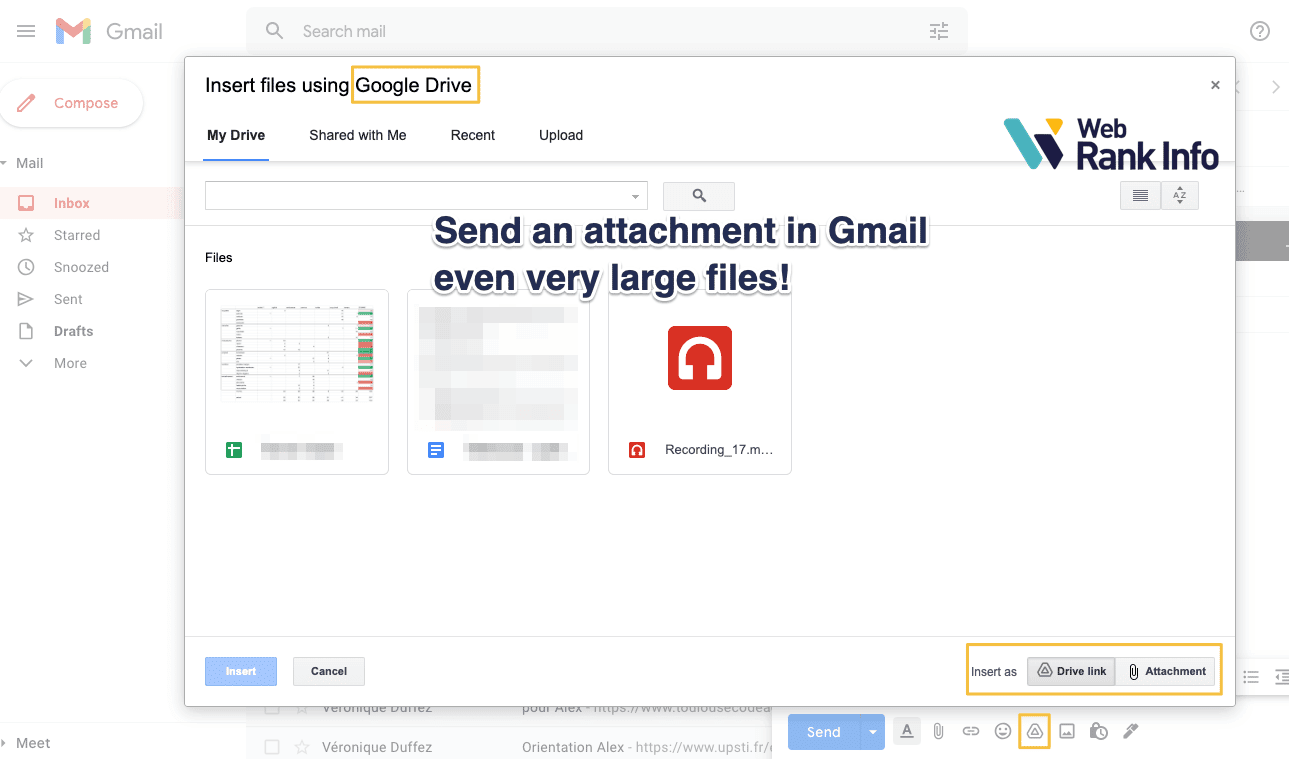
Trying to email a video, a high-resolution PDF or a whole folder of photos, only to be stopped by Gmail’s “attachment size limit exceeded” message? You’re not alone: it’s one of the most common Gmail frustrations. The good news: you can send files of several gigabytes through Gmail by hosting them on Google Drive, and Gmail often makes the switch for you automatically. This guide explains exactly how the limits work, why they exist, and every reliable way to send large files on desktop, Android and iPhone.
Gmail file size limits at a glance
| What | Limit | Good to know |
|---|---|---|
| Send limit (personal Gmail) | 25 MB per email (total of all files) | Above this, Gmail auto-inserts a Drive link |
| Receive limit (personal Gmail) | 50 MB | You can receive bigger than you can send |
| Google Workspace | 25 MB send | Enterprise Plus: 50 MB send / 70 MB receive (since Feb 2026) |
| Real usable size after encoding | ~17–18 MB | Base64 encoding inflates files by roughly 33% |
| Max file via a Google Drive link | Up to 5 TB per file | Within your available storage ( no practical email limit |
| Free Google storage | 15 GB | Shared across Gmail, Drive and Photos |
| Blocked file types | .exe & other executables | Blocked even inside a ZIP archive |
Why do email attachments have size limits?
The limit isn’t Google being stingy, it’s baked into how email works. Email was originally designed to carry text, not files. To attach a document, Gmail has to convert it into a text-safe format called Base64 (MIME) encoding, and that process inflates the file by roughly 33%. A 20 MB file on your hard drive becomes around 27 MB once encoded, which is why a file that looks like it fits can still bounce.
On top of encoding, size caps exist for two practical reasons: server performance (huge attachments would clog mail servers and slow delivery for everyone) and storage (every file you send and receive is stored and counts against your 15 GB quota). This is also why Google, like every provider, nudges you toward cloud links for anything large.
Gmail is far from alone here. Most email services sit in the same 20–25 MB range, so the recipient’s limit can be the real constraint (the smaller of the two limits wins):
| Provider | Attachment limit | Large-file option |
|---|---|---|
| Gmail | 25 MB send / 50 MB receive | Google Drive link |
| Outlook.com | 25 MB | OneDrive link (up to 2 GB) |
| Outlook desktop | ~20 MB (default) | OneDrive link |
| Orange & most ISPs | ~20–25 MB | Provider cloud / file transfer |
💡 Quick rule of thumb: Multiply your file size by 1.33. If the result is still under 25 MB, it will attach safely. To be safe, keep total attachments under about 18 MB, or use a Drive link instead.
The easiest fix: send big files with Google Drive
For most people, Google Drive is the fastest and most reliable way past the 25 MB wall — and the best part is that Gmail can do it for you. If you drop in a file larger than 25 MB, Gmail automatically uploads it to your Google Drive and replaces the attachment with a shareable link. Your recipient clicks the link to download the file, and they can still access it even if you later remove it from your email.
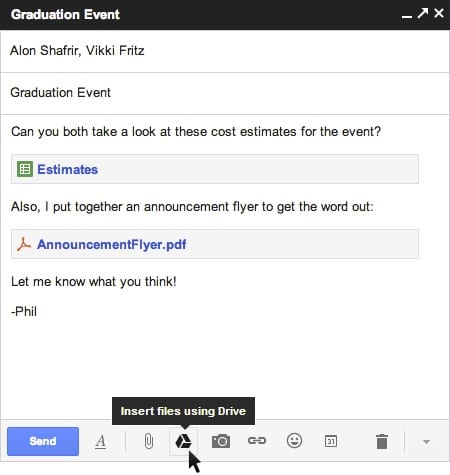
If you’d rather insert a Drive file yourself on a computer:
- Click Compose to start a new message.
- At the bottom of the window, click the Google Drive icon (Insert files using Drive).
- Select the file(s) you want to attach.
- Choose how to send them:
- Drive link: works for any file, including Google Docs, Sheets, Slides and Forms. Best for large files.
- Attachment: inserts a copy of the file; only works with files not created in Google Docs, Sheets, Slides or Forms.
- Click Insert, then Send.
An even quicker option: simply copy and paste the URL of a file already stored in Google Drive into the body of your message.
⚠️ Watch out: A Drive link only works as long as the file stays in your Drive with the right sharing permissions. If you delete the file or revoke access, the recipient’s link breaks instantly. Keep the file until they confirm they’ve downloaded it. Gmail will automatically check whether recipients have access and prompt you to update the sharing settings if needed — accept, or they’ll hit a “request access” wall.
Sending large files from your phone (Android & iPhone)
On Android
For a small file, attach it directly:
- Open the Gmail app and tap Compose 🖊.
- Tap Attach 📎.
- Tap Attach file or Insert from Drive.
- Choose the file you want to add.
If the file is too big, send it from Drive instead: tap Compose 🖊 → Attach 📎 → Insert from Drive → pick the file → Select → Send ➣.
On iPhone (iOS)
The process is almost identical in the Gmail app for iPhone and iPad:
- Open the Gmail app and tap Compose 🖊.
- Tap the paperclip 📎 icon at the top.
- To send a large file, tap Insert from Drive and pick your file — Gmail adds it as a link, bypassing the 25 MB limit.
- For smaller files, tap Attach file to pull from the Files app, or add photos and videos directly from your library.
- Tap Send ➣.
💡 Tip: Recording a long video on your iPhone? Upload it to the Google Drive app first, then insert it from Drive in Gmail. That avoids a failed send when a 4K clip quietly balloons past 25 MB.
Other ways to send large files
Compress the file into a ZIP
If your file is only slightly over the limit, compressing it may be enough. On Windows, right-click your files and choose Send to > Compressed (zipped) folder; on Mac, right-click and choose Compress. You can also use tools like 7-Zip, WinRAR, WinZip or PeaZip. Documents and spreadsheets shrink well; already-compressed files like JPEGs and MP4s won’t shrink much.
⚠️ Watch out: Zipping won’t sneak a blocked file type past Gmail. Gmail inspects the contents of archives, so a .exe stays blocked even inside a ZIP, and password-protected archives it can’t scan are rejected too.
Use a file-transfer service or split the file
If you’d rather not touch Drive, dedicated services such as WeTransfer, Dropbox or SwissTransfer let you upload a file and share a download link. And when compression isn’t enough, you can always split a large batch across two or three separate emails.
Can I increase my Gmail attachment limit?
Short answer: no. You can’t raise the 25 MB send cap on a personal Gmail account, and paying for more storage doesn’t change it. Standard Google Workspace accounts have the exact same 25 MB limit. The only exception is Google Workspace Enterprise Plus, which Google raised to 50 MB send / 70 MB receive in February 2026, and even that is controlled by your admin, not by you.
So rather than trying to lift the ceiling, the practical move is to go around it with a Google Drive link. It effectively lets you send files up to 5 TB.
Fixing common attachment problems
Your file is under 25 MB but still won’t attach
A common mistake is assuming a 24 MB file will always go through. Because of the ~33% Base64 overhead described earlier, a file that’s just under 25 MB on disk can encode to more than the limit and get rejected. If a file is within a few MB of the cap and won’t attach, that’s almost always why. Compress it, or let Gmail fall back to a Drive link.
“Blocked for security reasons” error
To protect against viruses, Gmail refuses executable files such as .exe (and many others: .bat, .msi, .jar, .scr…). If you try to attach one, you’ll see a “Blocked for security reasons” message. The fix: upload the file to Google Drive and share the link, or point your recipient to a place where they can download it directly.
Forwarding and replying with attachments
When you forward an email, its attachments are carried over automatically, there’s nothing to do. When you reply, attachments are dropped by default; to keep them, click the down arrow 🔽 at the bottom of the reply window and choose Include original attachments. To remove one you don’t want to resend, click the Delete button to the right of it.
Running out of space
Remember that every attachment you send and receive counts toward the 15 GB shared across Gmail, Drive and Photos. If you hit the ceiling, you won’t be able to send or receive attachments until you free up room or upgrade. Our guide on how to free up storage space in Gmail walks through the quickest wins.
Frequently asked questions
What is the maximum Gmail attachment size?
On personal Gmail accounts, the send limit is 25 MB total per email (all files combined), per Google’s official documentation. Above that, Gmail automatically uploads the files to Google Drive and inserts a link instead.
How large a file can I send with a Google Drive link?
Up to 5 TB per file, as long as it fits within your available storage. In practice, that means there’s no real email size limit once you switch to a Drive link.
Why is my file rejected even though it’s under 25 MB?
Gmail encodes attachments in Base64 before sending, which adds roughly 33% to the file size. A file just under 25 MB can therefore encode past the limit. Keep total attachments under about 18 MB, compress the file, or use a Drive link.
Can I send a .exe file through Gmail?
No. Gmail blocks executable files such as .exe for security, and the block applies even inside a ZIP archive. Upload the file to Google Drive and share the download link instead.
What is the attachment limit on Outlook and other providers?
Outlook.com allows 25 MB, while desktop Outlook defaults to around 20 MB. Most ISPs (such as Orange) sit in the 20–25 MB range. Since the smaller of the sender’s and recipient’s limits applies, the recipient’s mailbox can be the real constraint.
See also: Gmail translation tips — or head back to all our useful Gmail tips.