
In short: how do I find an archived email in Gmail?
Archived messages are never deleted: they simply leave your inbox and stay in All Mail. The quickest way to get one back is to type a keyword (sender, subject, or a word from the body) in the Gmail search bar. Archived emails are included in every search by default.
To browse only archived messages, search in:archive, or open All Mail from the left-hand menu. Once you’ve found it, tick the box in front of it and click Move to Inbox to unarchive it.
Where are the archives in Gmail? Where do messages go when you click on Archive? How do you find them again? Here is everything you need to know, plus a few tricks (search operators, offline access, bulk archiving and automatic rules) to master this feature.
“Archived” is different from “Deleted”
When you click on “Archive”, the mail is removed from the inbox so as not to clutter it, but it is not deleted. It is simply hidden, and it remains fully accessible through a search or by viewing all your messages. Technically, archiving just removes the Inbox label from the message — nothing is moved anywhere.
1st method to find an archived message in Gmail
Simply run a search in Gmail — for example by typing one or more words present in the email, the subject line, or the sender’s name.
In the search results, you’ll see archived emails alongside messages that are still in your inbox, because Gmail searches your entire account by default. If you’d rather display only archived mail, use the in:archive operator (see the dedicated section on search operators below).
See also: insert a Gmail signature and how to attach a file on Gmail
2nd method to see where archived messages are in Gmail
You can view all the emails in your account, whether they are archived or not:
- Log in to Gmail (on the app or in a web browser)
- Expand the menu (in the app, or the left column on a computer)
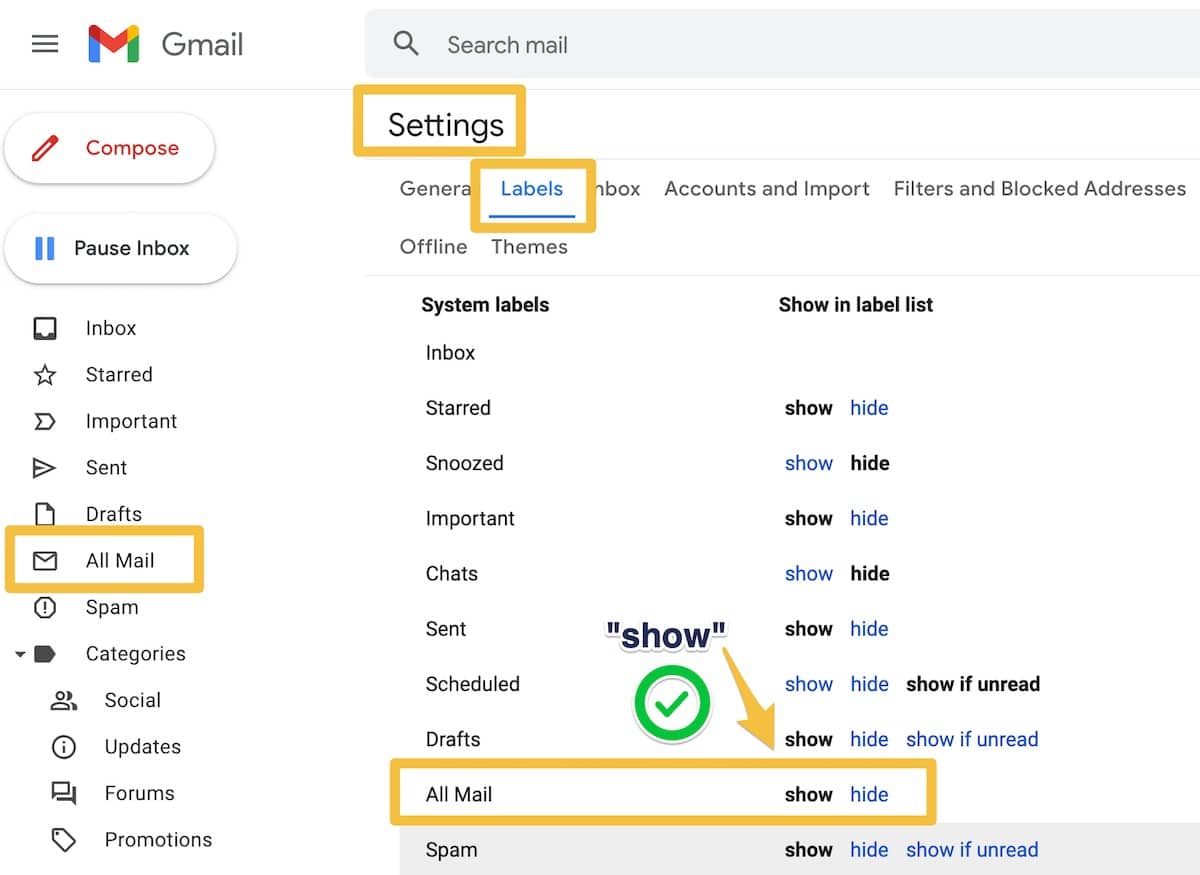
- Locate “All Mail” and click it
Note: if you need help… how to find your lost Gmail password
See also: translate an email in Gmail
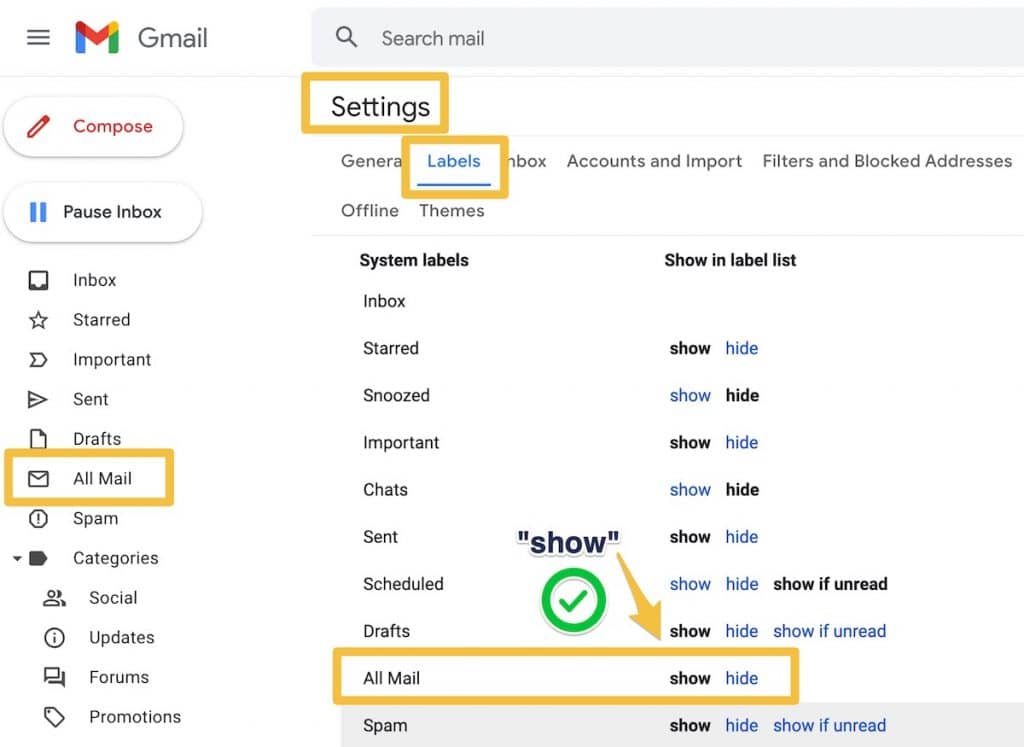
If you don’t see the “All Mail” link:
- look for a “More” link and click it — the “All Mail” link should then appear
- if that’s not enough, go to Gmail settings (cogwheel at the top right on a computer), click on “See all settings”, open the “Labels” tab and click “show” next to “All Mail”. Also tick the “Show in IMAP” box if you use the IMAP protocol to read Gmail elsewhere.
See also: empty the Gmail trash
Gmail search operators to find archived mail
Search operators are keywords you type directly into the Gmail search bar to filter results. They are by far the fastest way to locate archived emails, especially in a large mailbox. The most useful ones for archives are:
in:archive— shows only archived messages (sorted by archive date). This is the closest thing Gmail has to an “archive folder”.in:all— searches your entire mailbox, including archived mail (but excluding Spam and Trash).in:anywhere— searches everywhere, including Spam and Trash. Handy when you’re not sure whether a message was archived or deleted.-in:inbox -in:trash -in:spam— an alternative way to display archived mail on its own (everything that’s no longer in the inbox but hasn’t been deleted).
You can combine these with the classic operators to zero in on a message, for example:
in:archive from:john@example.com— archived emails from a specific senderin:archive subject:invoice has:attachment— archived invoices that carry an attachmentin:archive after:2024/01/01 before:2024/06/30— archived mail within a date range
How to access archived emails offline
Yes, you can read archived emails without an internet connection — as long as they have been synced beforehand. On a computer, this relies on Gmail’s offline mode, which works only in Google Chrome (not in Incognito mode).
- In Gmail, open the settings (cogwheel), then “See all settings”
- Go to the “Offline” tab and tick “Enable offline mail”
- Choose how many days of messages to sync: 7, 30 or 90 days (and, optionally, whether to download attachments)
- Save the changes
Once offline, open Chrome and go to Gmail as usual. You’ll be able to browse All Mail and search your synced messages — archived emails included — read them, and even archive, label or reply. Any change you make is applied automatically the next time you reconnect.
The important limitation: only messages within your chosen sync window are available offline. An archived email older than 7, 30 or 90 days (depending on your setting) won’t appear until you’re back online. On mobile, the Gmail app also keeps recent messages cached, so a recently archived email is usually readable without a connection.
How to unarchive an email in Gmail (move it back to the inbox)
There is no single “unarchive” button, but bringing a message back is quick. If it was archived recently, find it in “All Mail”; otherwise, locate it with a keyword search or the in:archive operator.
Once you’ve found it, tick the box in front of the line and click the “Move to Inbox” icon (a tray with a down arrow). On mobile, open the message, tap the three-dot menu and choose “Move to Inbox”. The message is restored — Gmail simply re-applies the Inbox label — and it reappears in your inbox on all your devices.
Good to know: if someone replies to an archived conversation, Gmail automatically brings the whole thread back into your inbox — no action needed on your part.
How to bulk archive emails in Gmail
To clear out your inbox in one go rather than message by message:
- Optionally run a search first to isolate the emails to archive (for example
from:newsletter@example.comorolder_than:1y) - Tick the checkbox at the top left to select all visible messages on the page
- If you want to include every matching conversation (not just the current page), click the link that appears: “Select all conversations that match this search”
- Click the Archive icon (a box with a down arrow) in the toolbar
The same principle works in reverse to bulk unarchive: open “All Mail”, tick the messages you want and click “Move to Inbox”.
Archive faster: keyboard shortcut and “Send & Archive”
To archive the selected or open message, press the e key. Keyboard shortcuts must be turned on first: go to Settings > “See all settings” > “General” tab, then set “Keyboard shortcuts on” and save.
You can also archive an email the moment you reply to it, thanks to a dedicated button. In Settings > “General” tab > “Send and Archive” section, tick “Show ‘Send & Archive’ button in reply”, then save. A new button appears in your replies.
How to create a rule (filter) to archive emails automatically
If certain emails should always skip your inbox (newsletters, notifications, automated reports…), set up a filter so Gmail archives them for you.
- Click the filter icon (sliders) at the right of the search bar — or go to Settings > “See all settings” > “Filters and Blocked Addresses” > “Create a new filter”
- Enter your criteria: sender (From), subject, words the message contains, etc.
- Click “Create filter”
- Tick “Skip the Inbox (Archive it)” — you can also add a label at the same time to keep things tidy
- Optionally tick “Also apply filter to matching conversations” to archive existing emails, then click “Create filter”
From now on, every matching email lands straight in “All Mail” (and under its label if you set one), without ever cluttering your inbox.
What is the purpose of archiving in Gmail?
Archiving lets you keep a clean, focused inbox without losing anything. Instead of deleting an email you might need later, you get it out of sight while keeping it fully searchable in “All Mail”. It’s the backbone of the popular “inbox zero” method: deal with a message (read it, reply, act on it), then archive it so your inbox only ever holds items that still require attention.
One caveat: archiving is about organisation, not storage. An archived email still counts towards your Google storage quota — to actually free up space you have to delete messages (and empty the Trash).
How long do archived emails stay in Gmail?
Indefinitely. There is no expiry date and no automatic clean-up: an archived email stays in your account for as long as you keep it, and you can find it in “All Mail” years later. It will only disappear if you delete it yourself.
This is a key difference from the Trash, where deleted emails are removed permanently after 30 days, and from Spam, which is also emptied automatically after 30 days.
See also: how to increase Gmail storage space for free
💡 Did you know?
An archived conversation isn’t gone for good — it reappears in your inbox on its own the moment someone replies to it. That’s why a thread you archived last week can suddenly show up again: a new message brought it back automatically. And here’s the counter-intuitive part: archiving never frees up storage. Archived and inbox emails weigh exactly the same against your 15 GB Google quota — only deleting (and emptying the Trash) actually reclaims space.
Archive vs Delete vs Mark as spam: the key differences
- Archive — removes the email from your inbox but keeps it in “All Mail”. It stays searchable, is kept forever, doesn’t free any storage, and comes back to your inbox if someone replies.
- Delete — sends the email to the Trash, where it is erased permanently after 30 days (recoverable until then). Emptying the Trash is what actually frees up storage.
- Mark as spam — moves the email to the Spam folder and trains Gmail to block similar senders in the future. Spam is also deleted automatically after 30 days.
Frequently asked questions
Where is the Archive folder in Gmail?
There is no Archive folder in Gmail. Archived messages simply lose their Inbox label and stay in All Mail, where you can find them by searching or with the in:archive operator.
How do I find an archived email in Gmail?
Type a keyword, sender or subject in the Gmail search bar, or open All Mail from the left menu. To list only archived messages, search in:archive.
Are archived emails deleted in Gmail?
No. Archiving only removes a message from the inbox without deleting it. Deleting, by contrast, sends the message to the Trash, where it is erased permanently after 30 days.
How long do archived emails stay in Gmail?
Indefinitely. Archived emails remain in your account until you delete them yourself, and they keep counting toward your storage quota.
Does archiving free up Gmail storage?
No. Archived emails still take up the same space. To reclaim storage you have to delete messages and empty the Trash.
How do I get an archived email back?
Find it in All Mail or through a search, tick the box in front of it, then click Move to Inbox to unarchive it.
Back to best Gmail tips