
The short answer: in Gmail, Cc adds recipients everyone can see, while Bcc adds hidden recipients no one else can see. Use Bcc whenever the people you email should not see each other’s addresses — a mailing list, a group of clients, an announcement to strangers. Here is the full picture at a glance, then the step-by-step for both.
| Field | Role | Do other recipients see this address? | Reached by “Reply All”? | When to use it |
|---|---|---|---|---|
| To | Primary recipient(s) — the person you are actually writing to | Yes (visible to To and Cc) | Yes | The main person expected to read or act |
| Cc (carbon copy) | Secondary recipients kept in the loop for information | Yes (visible to To and Cc) | Yes | People who should be aware but are not expected to reply |
| Bcc (blind carbon copy) | Hidden recipients — a private, invisible copy | No — invisible to everyone | No | Protecting privacy; groups who should not see each other |
To vs Cc vs Bcc in Gmail — the difference in one table
Why this matters: getting Cc and Bcc wrong is not just an etiquette slip. According to the UK data protection regulator (ICO), failure to use Bcc correctly is consistently one of the top 10 non-cyber data breach types reported to it, with close to a thousand incidents logged since 2019. Putting a whole mailing list in Cc exposes every address to every recipient — and that alone can count as a personal data breach.
Source: UK Information Commissioner’s Office (ICO), guidance on sending bulk communications by email.
What do Cc and Bcc mean in Gmail?
What does Cc mean in an email?
The Cc field is used to send the same email to several recipients at once. The abbreviation Cc stands for carbon copy. Everyone placed in Cc receives a copy of the message — and every recipient can see the full list of To and Cc addresses. Cc signals “you’re informed, but you’re not the main person I’m writing to.”
See also: how to translate an email in Gmail.
What does Bcc mean in an email?
The Bcc field sends the same email to several recipients in blind copy. The abbreviation Bcc stands for blind carbon copy. Each Bcc recipient gets the email, but none of them can see who else received it — not even the other Bcc recipients. Only the sender knows the full hidden list.
Note: you need to be logged into your Gmail account. If you don’t have one yet, here’s how to create a free Gmail account.
What’s the real difference between Cc and Bcc?
In one sentence: Cc recipients are public, Bcc recipients are private. Anyone in To or Cc can see (and reply to) every To and Cc address. Bcc recipients stay completely invisible — and because they’re invisible, they are also cut out of any “Reply All” thread that follows.
See also: how to add a signature in Gmail.
How to send a Cc email with Gmail
Here’s how to add recipients in Cc (standard, visible copy):
- Click Compose.
- Reveal the “Cc” line for your device:
- on mobile, tap the arrow ▽ on the right of the “To” line;
- on computer, click “Cc” on the top right.
- Type the name of a contact or an email address.
- Repeat for the other Cc recipients, separating them with a comma or semicolon.
- Write your message and send it.
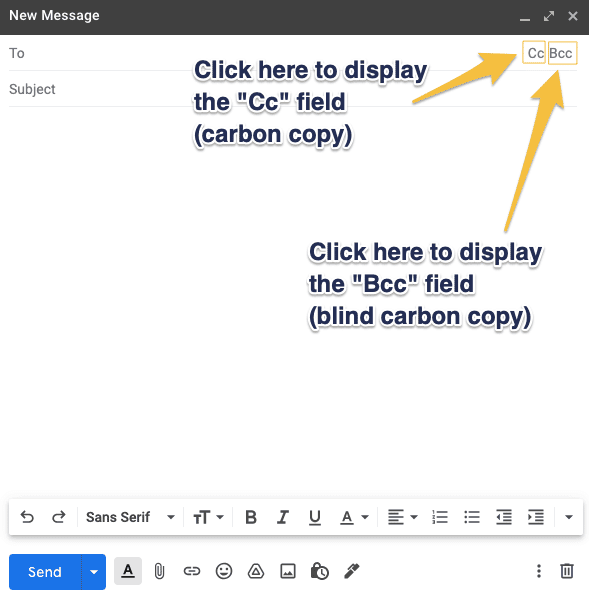
Note: you can combine fields. The “To” field is for your primary recipients; Cc is for secondary ones who just need to stay informed.
See also: how to empty the trash?
How to send a grouped Bcc email with Gmail
Here’s how to email several people in blind copy (Bcc):
- Click Compose.
- Reveal the “Bcc” line for your device:
- on mobile, tap the arrow ▽ on the right of the “To” line;
- on computer, click “Bcc” on the top right.
- Type a contact name or email address.
- Repeat for the other hidden recipients, separated by a comma or semicolon.
- Write your message and send it.
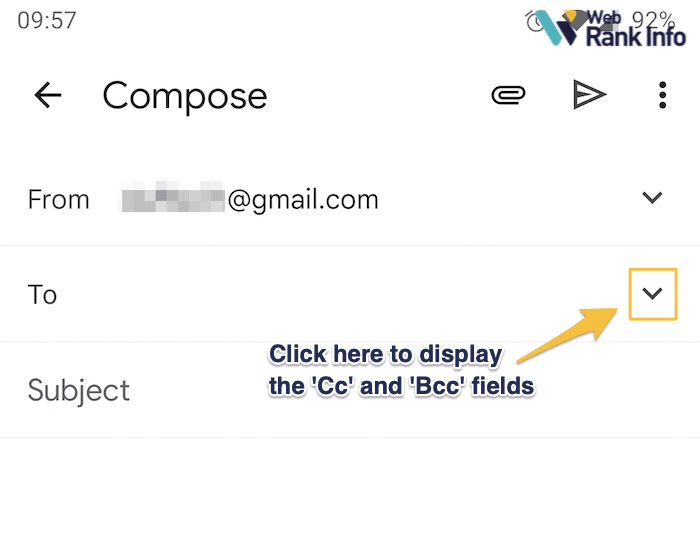
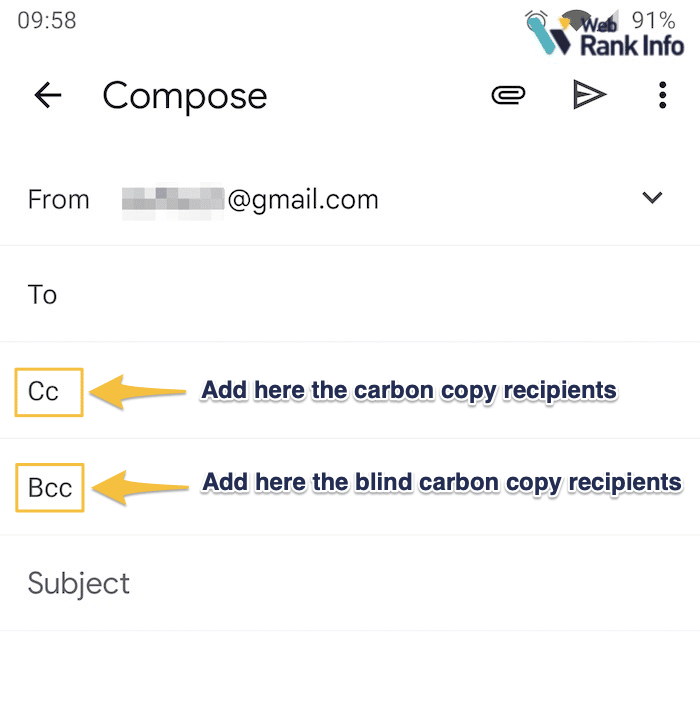
Tip: if your message needs at least one visible recipient, put your own address in the “To” field and everyone else in Bcc. Each recipient then sees only your name; all the others stay anonymous and hidden.
Why use blind carbon copy (Bcc)?
Bcc exists for four practical reasons:
- Privacy. It stops you from sharing everyone’s email address with everyone else — the single biggest reason to reach for Bcc.
- Data protection compliance. Under the GDPR, an email address is personal data. Exposing a whole list in Cc can qualify as a reportable breach (see the statistic above).
- No reply-all storms. Because Bcc recipients are invisible, they can’t be pulled into an endless “Reply All” chain.
- Discreet copies. You can quietly keep a manager, an archive address, or yourself informed without the main recipient knowing — though use this one thoughtfully.
When you should NOT use Cc
Cc is fine among people who already know each other and expect to be in a shared thread. It becomes a mistake — sometimes a costly one — in these situations:
- Recipients who don’t know each other. If the people on your list have no reason to see each other’s addresses, Cc leaks personal data to strangers. Use Bcc instead.
- Any mailing to a list, promotion, or announcement. Newsletters, event invites, club updates, customer notices — a Cc here exposes the whole database and invites reply-all chaos. This is exactly the scenario that lands organisations in front of regulators.
- Sensitive-membership groups. When simply being on the list reveals something private — patients, a support group, job applicants, people using a specific service — Cc can disclose that fact. Real ICO cases involved lists of people using HIV services being exposed this way.
- Mixed internal/external recipients. Cc’ing external contacts alongside colleagues can hand your team’s addresses to outsiders. Split the send or use Bcc.
- Introductions you’ll later exit. When you introduce two people and want to step out, move yourself to Bcc so the others don’t keep replying to you.
- As a passive-aggressive escalation. Cc’ing someone’s boss to apply pressure is an etiquette landmine. If a manager genuinely needs visibility, say so openly.
Can Cc recipients reply to all?
Yes. Anyone in the To or Cc field can hit “Reply All” and reach every visible recipient — the To and Cc lists both. Bcc recipients are the exception: they never receive Reply All messages, because the other recipients don’t know they exist.
This is why a large Cc list is risky: one person clicking “Reply All” can trigger a chain that lands in dozens of inboxes. If you want to inform many people at once without that risk, Bcc is the safer field.
Cc vs Bcc for large email lists
For a big group, Bcc beats Cc every time on privacy — but Bcc still isn’t built for true mass mailing, and Gmail’s own limits explain why:
| Account | Recipients per day | Important detail |
|---|---|---|
| Free Gmail | ~500 per day | Every name in To, Cc and Bcc counts as one recipient |
| Google Workspace (paid) | ~2,000 per day | Limits run on a rolling 24-hour window, not a calendar day |
Gmail sending limits (source: Google Workspace Help). A single email to 300 Bcc addresses uses 300 of your daily allowance.
Beyond privacy and limits, plain Bcc has other drawbacks for big lists: no personalisation, no unsubscribe link, weaker deliverability, and a higher chance of landing in spam. For anything above a modest one-off group, a proper tool is the right answer — see below.
A better alternative to Bcc for newsletters
Bcc is a workaround, not a mailing solution. For a recurring newsletter or any real campaign, use a dedicated email service instead. It removes the privacy risk entirely and gives you what Bcc can’t:
- An email marketing platform (Brevo, Mailchimp, MailerLite…) — each recipient gets their own individual copy, plus personalisation, a required unsubscribe link, and deliverability tuning.
- Gmail / Google Workspace “multi-send” (mail merge) — built into Gmail for Workspace users, it sends an individual message to each address with an automatic unsubscribe footer, so no one sees anyone else.
- A mail merge add-on for lighter, occasional sends where you want one personalised email per person.
Rule of thumb: Bcc for a handful of people who genuinely shouldn’t see each other; a real email tool the moment it becomes a “list.”
How to properly use Bcc for confidential information
A key point the ICO stresses: Bcc alone is not enough to protect genuinely sensitive personal data. It hides addresses, but one slip — a name typed into Cc by mistake — is irreversible. If your message involves confidential or sensitive information, layer these safeguards:
- Double-check the field before every send. Confirm each address is in Bcc, not To or Cc. This single habit prevents most breaches.
- Put your own address in “To.” It gives the message a visible recipient while keeping the real list hidden.
- Turn on Gmail’s “Undo Send” delay. Set it to the maximum (30 seconds) in Settings so you can catch a mistake before it leaves.
- For truly sensitive data, skip Bcc entirely. Use a bulk email service, mail merge, or a secure transfer method — the ICO explicitly recommends these over Bcc for sensitive information.
- Slow down on large sends. Rushing a big Bcc email is when mistakes happen. Prepare the list separately and paste it in last.
What’s the difference between To, Cc and Bcc in Gmail?
In short:
| Field | Recipient | Can see… |
|---|---|---|
| To | Primary recipients | To and Cc recipients |
| Cc | Secondary recipients | To and Cc recipients |
| Bcc | Hidden recipients | To and Cc recipients |
See also: Gmail attachment limitations
Note: in addition to the cc field, you can also indicate one or more recipients in the “To” field. These are the primary recipients, while the cc field is for secondary recipients.
Questions
How do I use Cc and Bcc?
Put secondary recipients in Cc and the ones you want to keep hidden (from each other and everyone else) in Bcc. In Gmail, click “Cc” or “Bcc” to reveal each field first.
Who can see the Bcc recipients?
No one but the sender can see the Bcc recipients. No recipient can see the Bcc list — not even the people who are themselves in Bcc.
Can everyone be in blind copy?
Yes, though some mail systems dislike an email with no visible recipient. If yours refuses to send, just add your own address in the “To” field.
What does bcc mean in an email?
It means Blind Carbon Copy (or simply blind copy). The recipient(s) of an email placed in bcc are not known by the other recipients.
What does cc in a mail mean?
“Cc” in an email (Gmail or not) means Carbon Copy. The recipient(s) of a mail placed in cc receive the mail like all the others, and all the recipients know that they are in the cc field. Use the cc field to show that these recipients are less important than those listed in the “To” field.
How many email addresses in Gmail bcc?
The Gmail documentation does not provide a maximum number of recipients in bcc (or in cc for that matter). It seems to depend on the reputation of the account sending the email, as well as the presence of attachments, and probably other factors. If you have a lot of recipients, it’s best to have a mailing or a Google Workspace subscription.
Undisclosed Recipients: Is this spam or hacking?
No! The definition of Undisclosed Recipients is “unknown recipients”. This happens when you receive an email that was only sent to hidden recipients (no email address was in the “To” or “Cc” fields). Undisclosed Recipients means that the system can’t display the list of recipients.
If I reply to an email, do the Bcc recipients receive it?
No. Your mailbox doesn’t know the Bcc addresses even exist, so replies never reach them. The thread simply ends for hidden recipients.
How to display the names of the recipients in Bcc?
It is not possible because the list of Bcc emails remains secret. Only the person who sent the email can know the list of invisible hidden recipients.
Can I reply if I was a hidden (Bcc) recipient?
Yes, but be careful. Replying only to the sender is fine. If you use “Reply All,” you’ll reveal that you were secretly on the list, which can surprise the other recipients — so think before sending.
Is “blind copy” Cc or Bcc?
Blind Copy is “Bcc”. Cc means carbon copy (visible); Bcc means blind carbon copy (hidden). To blind-copy someone, put their address in the Bcc field.
How to find the line or the bcc field in Gmail?
Everything is explained here! Basically: on cell phone, press the arrow ▽ located to the right of the “To” line, and on computer click on “bcc” (displayed on the top right).
Should I put the recipient in cc or bcc (Gmail or other mail)?
The choice is yours! Put your main recipients in the “To” field, then the secondary recipients in the “Cc” field and finally in the “Bcc” field the recipients that nobody should be able to see.
How to add a blind copy recipient on Gmail?
Everything is explained here! Basically, enter his address in the “Bcc” field. This way, no other recipient will be able to know that he or she also receives the email.
Can I know if others have received the hidden mail?
No, it is impossible! You have no way of knowing if others have received the same email as you, but by being in the hidden recipients. You can suspect that this is the case if 100% of the recipients are hidden (your mailbox sometimes displays Undisclosed Recipients).
When should I use Bcc?
Whenever recipients shouldn’t see each other’s addresses, or shouldn’t even know others received the same email — associations, clubs, client announcements, and any list. If you’d put these people in To or Cc, they’d likely (and rightly) complain.
Does each Bcc recipient count toward Gmail’s sending limit?
Yes. Gmail counts every address in To, Cc and Bcc as one recipient. An email to 400 Bcc addresses uses 400 of your daily allowance (roughly 500 for free Gmail, 2,000 for Workspace).
What does “Undisclosed Recipients” mean?
It’s not spam or hacking. It appears when an email was sent only to hidden recipients — no address in To or Cc — so the system has no visible list to display.
Back to Gmail Tips & Tricks