
Email is still the backbone of your digital life in 2026: you need it to sign in almost everywhere, to receive invoices, and to talk to clients. The good news is that creating a free email address takes about 2 minutes. The part most tutorials skip is which provider you should actually choose, and the handful of expert tricks that save you real trouble later.
This complete guide walks you through creating a Gmail account step by step, compares the best free email services with real 2026 figures (storage and sending limits), explains how to get a free professional address with your own domain, lists the most secure and private providers, and shares expert tips you will not find in a standard manual.
Did You Know? Surprising Facts About Email in 2026
- Roughly 361 billion emails are sent and received every single day worldwide, about 4% more than last year, and there are close to 4.4 billion email users on the planet.
- The average office worker receives around 121 emails and sends around 40 every working day.
- The @ symbol in every address goes back to 1971, when engineer Ray Tomlinson picked it to separate the user name from the machine name for the very first networked email.
- In Gmail, dots are ignored: john.doe@gmail.com and johndoe@gmail.com land in the exact same inbox.
- In March 2026, Google quietly changed its wording from “15 GB” to “up to 15 GB” of free storage, and now nudges new users to confirm a phone number to unlock the full amount.
Which Free Email Service Should You Choose? (2026 Comparison)
Not all free inboxes are equal. Some give you huge storage, some show ads, and a few encrypt everything so tightly that not even the provider can read your mail. Here is how the main free services compare on the numbers that actually matter.
| Provider | Free storage | Daily sending limit | Max attachment | Ads |
|---|---|---|---|---|
| Gmail | 15 GB * | 500 / day | 25 MB | Yes |
| Outlook.com | 15 GB (+ 5 GB cloud) | ~300 / day | 20 MB | Yes |
| Yahoo Mail | 1 TB | ~500 / day | 25 MB | Yes |
| iCloud Mail | 5 GB ** | 1,000 / day | 20 MB | No |
| Proton Mail | 0.5 to 1 GB | 150 / day | 25 MB | No |
| Tuta | 1 GB | Not published | 25 MB | No |
| Zoho Mail | 5 GB | ~300 / day | 25 MB | No |
| GMX / Mail.com | 65 GB | Varies | 50 MB | Yes |
In plain terms: pick Gmail if you want the best all round experience and ecosystem, Yahoo Mail if you never want to think about storage again, Zoho Mail if you want a clean ad free inbox, and Proton Mail or Tuta if privacy is your priority. The rest of this guide starts with Gmail, because it remains the default choice for most people.
💡 Expert tip. Storage size is a distraction for most people. A typical personal inbox rarely fills even 5 GB of pure email in years. What quietly eats your Gmail quota is Google Photos and Google Drive, which share the same 15 GB pool. Watch those, not your messages.
Why Create a Google / Gmail Account?
Creating a Gmail account actually unlocks a whole set of Google products and services, including Google Docs documents, Google Drive cloud storage, YouTube videos, Google Maps directions, Google Scholar search, and of course your smartphone or tablet if it runs Android.
And Gmail itself is very good mail: fast, practical, and backed by a large online storage. Discover other reasons to use Gmail. If you change your mind later, you can always delete your Gmail account.
To create a Gmail email account, you need a Google account:
- If you already have a Google account, you just need to log in to the Gmail service with your Google account username and password. Click here to sign in and go to the right page.
- Otherwise, you have to create a Google account, which lets you create a Gmail address at the same time. Follow the steps below.
How to Create a Gmail Email Address in 2 Minutes
Follow these steps:
- Go to the webpage https://accounts.google.com/SignUp
- Fill in the fields: first name, last name, username and password, then go to the next step
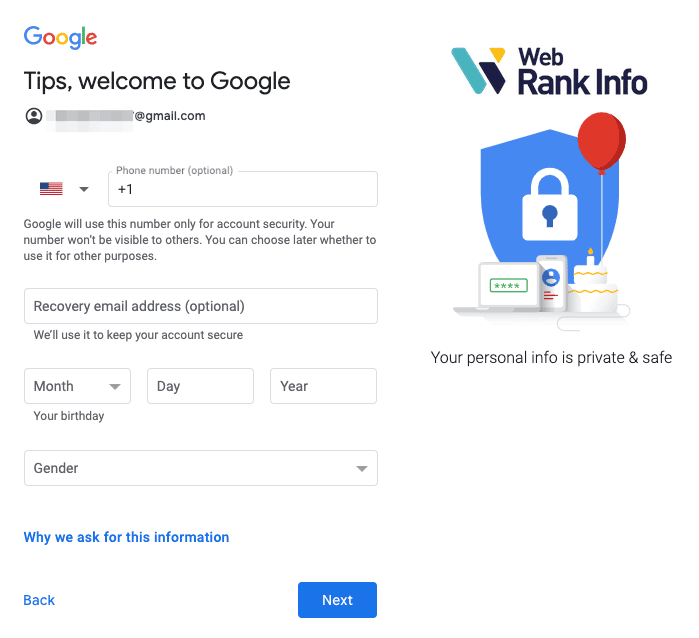
- Enter your phone number to receive an activation code (by SMS or voice call)
- Type in the code you received
- Once validated, you reach a screen where you can:
- remove the phone number you provided (if you do not want it to stay linked to your Google account)
- provide a recovery email address (useful to secure your account)
- enter your date of birth (day, month, year): this is mandatory
- indicate your gender: choosing is mandatory, but you can select “not specified”
- The last step is to approve the “Privacy Policy and Terms of Use”
✅ It’s done! Here is a short summary in 2 images.
1️⃣ The first step is to create your Google account, without forgetting to choose your Gmail address.
❓ Did you know? A Gmail address is optional inside a Google account: you can click “use my current email address instead”. That is not the goal here, otherwise you will not have a Gmail address at all.

2️⃣ Then Google asks you for a phone number to send you a code:
⚠️ Pitfall to avoid. Your new 15 GB is shared between Gmail, Drive and Photos. If Photos fills the quota, Gmail stops sending and receiving too, and messages bounce back to the sender. Check your real usage at one.google.com/storage from time to time, and empty Spam and Trash first when you need space.
See also: how to forward with attachments in Gmail
Gmail Signup Tips
Choosing a username for your mailbox
Think carefully about whether you want to stay anonymous (using a nickname) or, on the contrary, highlight your identity. In the second case, try the format firstname.lastname@gmail.com, even if it is probably already taken.
No need to add a dot or remove one: dots are ignored, to protect the first account created. For example, if claire.dupont@gmail.com already exists, then Google treats clairedupont@gmail.com (without the dot) as the same mailbox.
💡 Expert tip. If your ideal address is taken, do not pile up numbers like john1987xy. Add a short, meaningful word instead (john.doe.paris, john.doe.photo). It stays easy to say out loud, easy to remember, and it looks far more credible than a random string of digits.
See also: add other email addresses in Gmail
The + trick: unlimited aliases and disposable Gmail addresses
This trick is not that well known, and yet it is extremely practical. You can create as many secondary addresses as you want inside the same Gmail account, without configuring anything. In any signup form, just use the + sign to build an alias.
If your Gmail address is claire.doe@gmail.com, then you can hand out claire.doe+holidays@gmail.com to whoever you want, and you will still receive every message in your normal inbox. Create one per child, per activity, per event, or as a true disposable email.
Even better: you can create Gmail filters to sort messages automatically based on the alias. So you never need a separate address on Outlook, Yahoo or another provider.
💡 Expert tip. Use a different alias for every site you sign up to, for example you+shopname@gmail.com. If you later start getting spam addressed to you+shopname, you know exactly which company leaked or sold your address, and you can filter it straight to Trash.
⚠️ Pitfall to avoid. A few websites wrongly reject the + sign in the email field, and some ignore the dot rule. If a signup refuses your alias, fall back to your plain address without + or dots.
The phone number linked to your Gmail account
As you noticed, Google asks for a phone number to finalize the account. There are two sides to this:
- it is good, because it secures the account, especially with two factor authentication
- it is less good if you want to stay discreet and not hand everything to Google
One workaround is to provide a number during signup, then delete it after you have entered the code received by SMS, before finalizing the account. That number can even belong to someone else, or be yours and then removed.
Honestly though, there are usually more pros than cons to giving your real number. The consequences of a hacked Gmail mailbox are often serious, and the number does not just protect Gmail: it protects every Google service tied to that account. Since March 2026, Google also links part of your free storage to a confirmed phone number, so removing it may cost you space.
💡 Expert tip. The single most valuable thing you can do right after creating any inbox is to turn on two factor authentication (2FA) and add a recovery email. That does more for your safety than the choice of provider itself.
Power user tricks most tutorials skip
- The sending limit is a rolling window, not a midnight reset. Free Gmail caps at 500 emails per day, but those slots free up 24 hours after you used them, not at midnight. You cannot beat it by sending a batch at 11:59 pm and another at 12:01 am.
- CC and BCC count individually. One email to 50 people in CC burns 50 of your daily slots, not 1. Replies and auto responses count too.
- Bursts get you throttled. Sending 80 to 100 messages in a 10 minute window can lock the account for up to 24 hours, well below the daily ceiling. Spread sends across hours.
- Find space in seconds. Type
has:attachment larger:10Min the Gmail search bar to surface the biggest attachments eating your quota.
Login to Gmail
To sign in to your email, follow the instructions for your device.
How to connect on a computer
On a computer, go to https://mail.google.com/ then enter your Gmail address and password. If that is not enough, click here to sign in. You then land in your Gmail inbox. See also how to change your Gmail password.
How to connect on phone or tablet
On Android and iOS (iPhone or iPad), open the Gmail app and check which Google account it opens with. If it is not the right one, tap your profile picture, then “Add another account”. For details: connect to Gmail and read your emails.
Alternate Google Account email addresses
A Google Account is made of several kinds of addresses:
- Google account email address: it cannot be changed.
- Recovery email address: optional, it strengthens security. This is where Google contacts you if there is unusual activity or if you lose access. Click here to set it.
- Contact email address: where Google sends information about the products you use. It does not have to be a Gmail address. Click here to check or add one.
- Secondary email addresses: extra addresses you can use to sign in, and that can help you recover access. Click here to view or add one.
- “About me” profile emails: addresses you can share with others across Google products such as Drive or Photos.
See also: What does Bcc mean in Gmail?
How to Create a Free Professional Email Address (and Its Real Limits)
A professional email address uses your own domain, like you@yourcompany.com, instead of @gmail.com. It builds trust, protects your brand, and looks credible to clients and partners. The honest catch: a truly “100% free” professional address barely exists, because you always need to own a domain name first.
What you actually need is two things: a domain name (around 10 to 15 € per year at most registrars, though some hosts bundle it free for the first year), and a mailbox service able to host email on that domain.
The closest thing to free is Zoho Mail’s forever free plan, which can host email on one custom domain for up to 5 users, with 5 GB each, at no cost (available in selected regions). Some web hosting plans also include mailboxes on your domain as part of the package.
⚠️ Pitfall to avoid. Using something like yourcompany2024@gmail.com as a business address. It looks amateur, weakens trust, and free @gmail.com accounts have tighter deliverability, so your outreach is more likely to land in spam. A real domain address pays for itself fast.
The real limits of a free professional inbox are worth knowing before you commit:
- Zoho’s free plan has no IMAP or POP access, so you cannot use Outlook, Apple Mail or Thunderbird, only Zoho’s own webmail and app.
- No email forwarding on the free plan, and a single domain with 5 mailboxes maximum.
- No advanced admin, retention or SMTP relay features, and tighter sending limits than paid plans.
If email is central to your business, a low cost paid plan is usually worth it: Zoho Mail from about 1 €/user/month, Microsoft 365 from about 6 €/user/month, or Google Workspace from about 7 €/user/month, each with a custom domain, more storage, and much higher sending limits.
💡 Expert tip. Buy your domain from an independent registrar, separate from your mailbox host. If you own the domain yourself, you can switch email providers later without ever changing your address. Tying the domain to the mail host is convenient on day one and painful the day you want to leave.
The Best Secure and Private Free Email Services
If privacy matters more than raw storage, switch to an end to end encrypted provider. With these services, your messages are scrambled before they leave your device, so not even the company can read them. Here is a short list of the most trusted secure free email services in 2026:
- Proton Mail (Switzerland): the most popular encrypted email, with more than 100 million users. Free plan of 500 MB (up to 1 GB after a short setup), 150 messages per day, zero ads, open source and independently audited, protected by strict Swiss privacy law.
- Tuta, formerly Tutanota (Germany): 1 GB free, encrypts even subject lines and contacts, uses quantum safe encryption, fully open source, and runs on renewable energy. Ideal if metadata privacy is your top concern.
- Mailfence (Belgium): OpenPGP support with a built in calendar and documents, plus a small free tier for privacy minded users.
- StartMail (Netherlands): from the team behind Startpage, strong on disposable aliases and custom domains, ad free and no tracking (mostly a paid, privacy first service).
- iCloud Mail (Apple): 5 GB, ad free, and tightly integrated across iPhone, iPad and Mac. Not end to end encrypted for standard mail by default, but a solid private choice for Apple users.
- Zoho Mail: genuinely ad free and privacy friendly, though not end to end encrypted. A good middle ground for people leaving Gmail who do not need full encryption.
⚠️ Pitfall to avoid. “Encrypted” is not the same as “end to end encrypted”. Only providers like Proton Mail and Tuta make your messages unreadable to the provider itself. And even they cannot hide your IP address, or protect a message the moment you send it to a Gmail or Outlook recipient, who keeps a readable copy on their side. For real anonymity, pair secure email with a VPN.
Other Questions & Answers
How to create a Gmail account without a phone number?
📵 Do not believe what the tutorials say on this subject, they are not up to date: it is now mandatory to indicate a phone number. But read this tip that can help you out.
How to create a temporary or disposable Gmail address?
🗑️ Once you have a gmail address, you can add the + sign and the word of your choice behind it, to create another address. Read here how to do it in practice .
How to open a Gmail account for free?
🆓 Follow this tutorial by choosing the type of account at the beginning. Choose “Create an account for me” and not “Create an account to manage my business”.
What is the format of the Gmail username?
@ It takes between 6 and 30 characters, consisting of letters, numbers or a point, knowing that in fact the point is ignored.
Can we have an email on gmail.co.uk instead of gmail.com?
🇬🇧 No it’s not possible, the only extension used for Gmail accounts is @gmail.com (or @googlemail.com)
What if the username is already in use?
👥 If the name you have indicated is not available, you must add variants in order to distinguish yourself sufficiently from the one taken. Add an original word or otherwise a series of numbers.
How to change your first name or Gmail account name?
↩️ Fill out the form located here.
Where can I find help logging in to my Gmail account?
📍 See Google Help to sign in on desktop, Android, or iOS.
How to have a professional email address?
You have to buy a domain name (in the name of your company or whatever you want), then create a mailbox. Your web host should be able to explain how to do this.
Which free email service gives the most storage?
🗄️ Yahoo Mail leads by far with 1 TB of free storage. GMX and Mail.com offer 65 GB, Gmail and Outlook.com give 15 GB each, while Zoho Mail and iCloud Mail give 5 GB.
What is the most secure free email service?
🔒 Proton Mail and Tuta are the top choices. Both are end to end encrypted and open source, and neither can read your messages. Tuta even encrypts subject lines.
Can I create a free professional email with my own domain?
🏢 Partly. You must first buy a domain name, then Zoho Mail can host it free for up to 5 users in selected regions, but without IMAP, POP or forwarding on the free plan.
How many emails can I send per day with a free account?
📨 Gmail allows 500 emails per day and Proton Mail 150 messages per day. Other providers vary, and limits depend on the age and reputation of your account.